About this Story
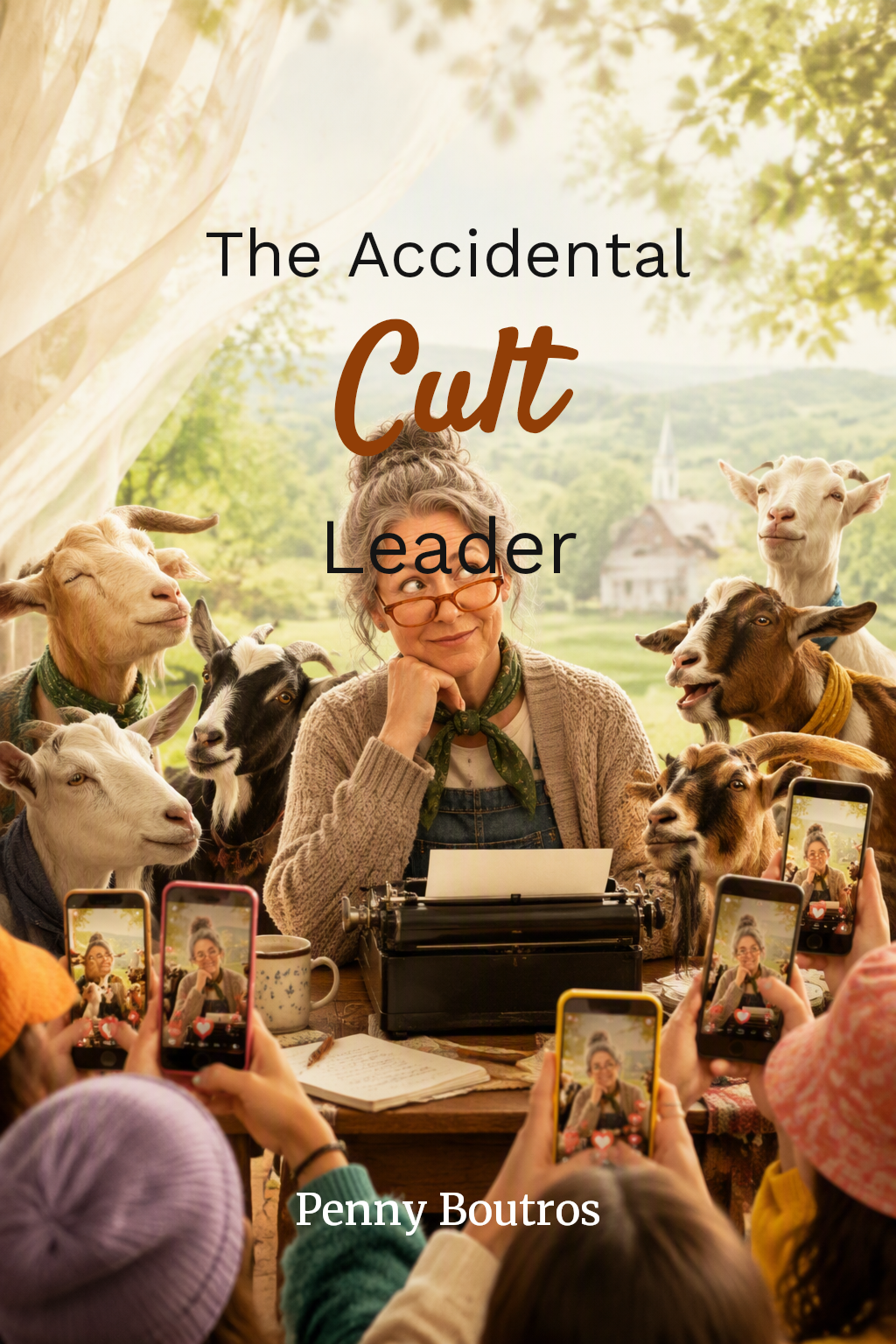
Margery Fell is fifty-nine, widowed, and wants nothing more than to tend her six goats and write a little Monday newsletter from a drafty farmhouse in central Vermont. Then one essay about the liberating uselessness of mattering catches fire on TikTok, and her eight hundred subscribers become a hundred and forty thousand in a weekend. Strangers send unsolicited money. Strangers send unsolicited goats. Strangers organize a retreat in her village without consulting her, incorporate her as a non-profit, and mistake her deep reluctance for sacred humility. By the time the IRS writes, the Vermont Department of Health calls, and her second-in-command stages an unsanctioned solstice ceremony, Mags is the reluctant leader of a movement she never founded and must now gracefully dismantle. A dry, slow-burning comedy about grief, decency, and the terrible things that can happen when strangers on the internet decide you are profound.
The Monday Newsletter
The newsletter started the way most of my recent bad decisions had started, which was on a Monday morning at the kitchen table with the dog asleep on my feet and the coffee too weak because I keep forgetting that the little scoop in the bag is not the tablespoon it resembles. My husband had been dead for eleven months. The house we had bought together sight unseen, in a village in central Vermont whose chief distinguishing feature was that it had once, briefly, been the birthplace of a minor Unitarian pamphleteer, was still arranging itself around my absence of him. I had six goats. I had three acres. I had retired from the Brattleboro public library after twenty-nine years in which I had developed opinions about the Dewey Decimal System that I will take to my grave. I had a Substack because my niece had set one up for me over Christmas, ostensibly so I would stop emailing her the same recipe for white bean soup every February.
I called it Thoughts From the Barn, which was both accurate and, I thought, sufficiently off-putting to keep the subscriber count down around the eight hundred people who had already forgiven me for a great deal over email. The essays were short. I wrote about the goats, who are named after minor Edwardian novelists and who will eat a sweater off a clothesline if you give them three seconds and a breeze. I wrote about bad television, a genre I havegrown to respect the way some people respect wine. I wrote about widowhood, carefully, because widowhood is the kind of subject that attracts the wrong kind of sympathy the way porch lights attract the wrong kind of moth, and I had already turned down two offers from what I suppose we must call the grief industry.
My readers were, as near as I could tell, middle-aged women in Ohio and one remarkably loyal man in Dunedin, New Zealand, who occasionally sent me photographs of his own goats by way of rebuttal. The comments were generous and mostly about cheese. For a full year I wrote into this very specific, very small room, and the room felt honest to me, and I did not think about it much more than I think about the size of my own shoes.
The essay that broke everything was written on a February Sunday in which the temperature at noon was eleven degrees and Gerald — the dog, a coonhound mutt of indeterminate opinions — had eaten most of a sponge. I had spent the morning on the phone with the vet, who assured me that sponges pass, and I had spent the afternoon trying and failing to care about a novel a friend had recommended. I sat down at the table at five, in the thin light off the snow, and I wrote seven hundred words under the working title The Enormous Relief of Not Mattering.
I will not reproduce it here because the essay is not mine anymore, and has not been mine since about twelve hours after I hit publish, and also because reading it back makes me feel the way I feel when I see a photograph of myself at the end of a long flight. The argument, insofar as it had one, was that much of middle age, and probably most of grief, is the process of realizing you were never the protagonist of anything. Not of your marriage. Not of your job. Not of the planet. That the
Sign in to join the conversation.
Be the first to leave a comment.