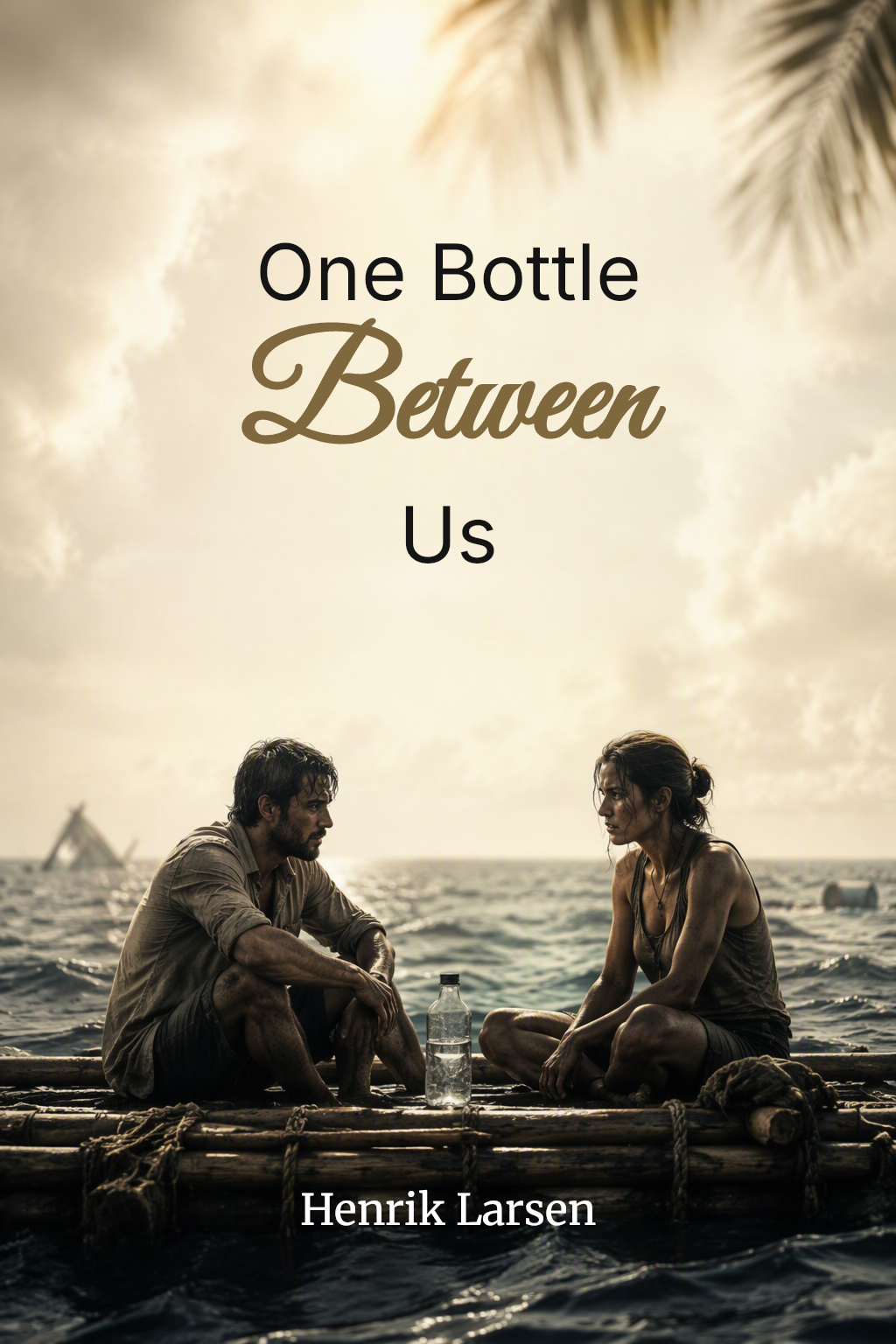

About this Story
Two strangers, the only survivors of a capsized ferry, share a single raft and one bottle of water across four days at sea — each hiding why they were really aboard.
What-The-Sea-Kept
The ferry went over in the time it takes to spill a cup, and the sea kept almost everyone.
Mara came up under the wrong sky — black where it should have been grey, the lights of the Halvarsen already gone beneath her, fuel slick on her lips. She did not remember choosing to swim. She remembered only the cold, which was not a temperature but a hand, and then the orange shape riding the swell twenty meters off, half-inflated, turning slow circles like something stunned.
She reached it the way drowning people reach things, with the last of a strength she hadn't known she was spending. She got an arm over the gunwale, then a leg, then she was inside it, retching seawater, and that was when she understood she was not alone.
A man lay across the far side of the raft, one hand locked white-knuckled on the lifeline, the other curled around a single clear bottle of water. He was big through the shoulders and grey in the face, and he watched her come aboard with the flat, careful stare of an animal deciding whether the new thing is a threat.
"Anyone else?" she managed.
"No." His voice was wrecked. "Just us. I've been watching for an hour. Nobody else came up." He said it without softness, a fact laid down between them like a stone.
She lay back against the cold rubber and let the swell rock her and tried to make the world hold still. Grey light was beginning in the east. The raftwas a six-person canopy model gone wrong — the canopy torn away, the survival pack ruptured and emptied by the sea, its mirror and its flares and its rations all gone to the bottom with everyone she'd shared a deck with the night before. What was left was the raft, the two of them, and the bottle the man held against his chest like a child.
"How much water?" she asked.
He turned it so she could see. Maybe a liter and a half. Not even.
"That's all of it?"
"That's all of it." His eyes didn't leave her face. "And before you ask — no, I don't know how to make more. So we drink it slow, and we don't fight about it, and maybe a boat comes before it runs out."
Mara nodded. She was a careful person by trade; she knew how to take a measure of a man, and what she took of this one was that he was frightened and trying not to be, which made him honest, which made him useful. She did not tell him her name yet. She did not tell him she had boarded the Halvarsen under a name that wasn't hers, or what was sewn into the lining of the jacket she'd lost to the water, or who in three countries was very glad to believe her drowned.
"I'm Mara," she said, which was true, more or less.
"Osei." He loosened his grip on the bottle by a fraction, the smallest possible offering. "We ration from now. One mouthful at dawn, one at dusk. Each."
"And what's a mouthful?"
He almost smiled. It was a terrible expression on a face that grey. "We'll argue about that tomorrow."
The sun came up over an empty horizon in every direction, and the two strangers sat at opposite ends of the small orange world the sea had left them, and began, without saying so, the long arithmetic of staying alive on less than they needed and far more than they trusted.
Sign in to join the conversation.
Be the first to leave a comment.