
About this Story
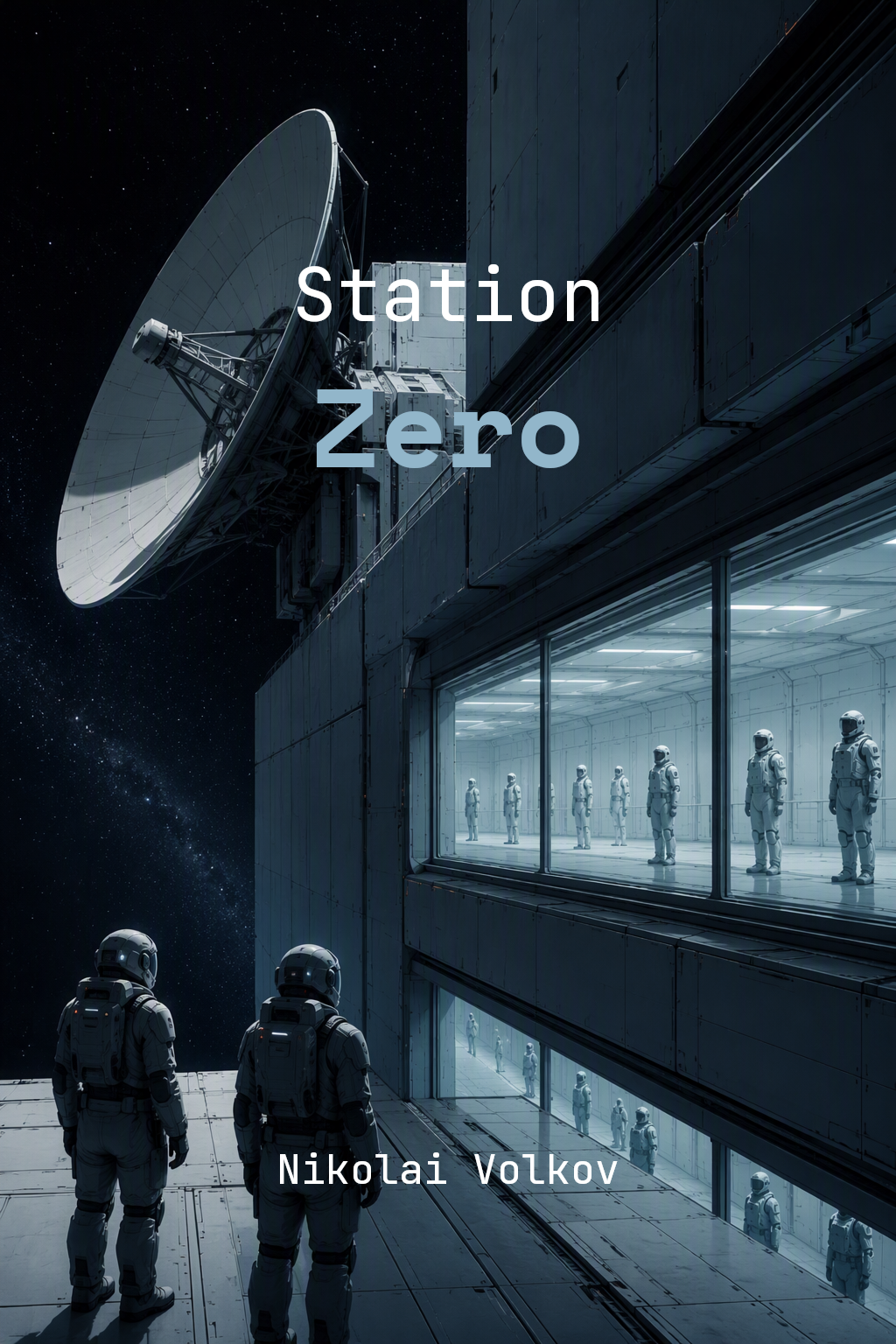
The first deep-space relay station has been transmitting for fifty years with no crew aboard. When a maintenance team finally arrives, they find the station occupied — by versions of themselves who claim to have been there all along.
The Maintenance Run
Station Zero had been alone for fifty-three years. It was the first object humanity had placed beyond the heliosphere — a relay station the size of a small office building, launched in 2031, designed to receive transmissions from the inner solar system and boost them toward the stars. It required no crew. Its systems were automated, its power supply nuclear, its operational lifespan estimated at a century. For fifty-three years, it had done exactly what it was built to do: receive, amplify, transmit. The data it relayed was routine — scientific telemetry, navigational updates, the administrative communications of a civilization slowly expanding beyond its birth system. Station Zero was infrastructure. It was not supposed to be interesting.
Chief Engineer Katya Volkonsky found it interesting anyway. She had been assigned to the maintenance mission — the first physical inspection of Station Zero since its launch — because she was the best systems engineer in the fleet and because she had requested the posting, which surprised her superiors, since maintenance runs to automated stations were considered the career equivalent of being sent to count trees in Siberia. But Katya had been reading the station's telemetry for two years, and she had noticed something that the automated monitoring systems had not flagged because it fell outside their detection parameters. Station Zero'spower consumption was wrong. Not by much — a fraction of a percent, well within the tolerance for a fifty-year-old system — but consistently wrong, and in a direction that suggested the station was running something its design specifications did not account for. Something was using power on Station Zero that was not supposed to be there.
The maintenance ship docked at 09:00 UTC, and Katya led her team of four through the airlock with the efficient calm of someone who had boarded dozens of stations and expected this one to be no different. The airlock cycled. The inner door opened. And the corridor beyond was lit, which was the first wrong thing, because Station Zero's interior lighting was designed to activate only in the presence of crew, and there had been no crew for fifty-three years. The second wrong thing was the smell — coffee, fresh and strong, drifting down the corridor from the direction of the station's common area. The third wrong thing was the woman standing at the end of the corridor, wearing a maintenance uniform identical to Katya's own, who looked at her with an expression of weary recognition and said: "You're late. We expected you six months ago."
Sign in to join the conversation.
Be the first to leave a comment.