Über diese Geschichte
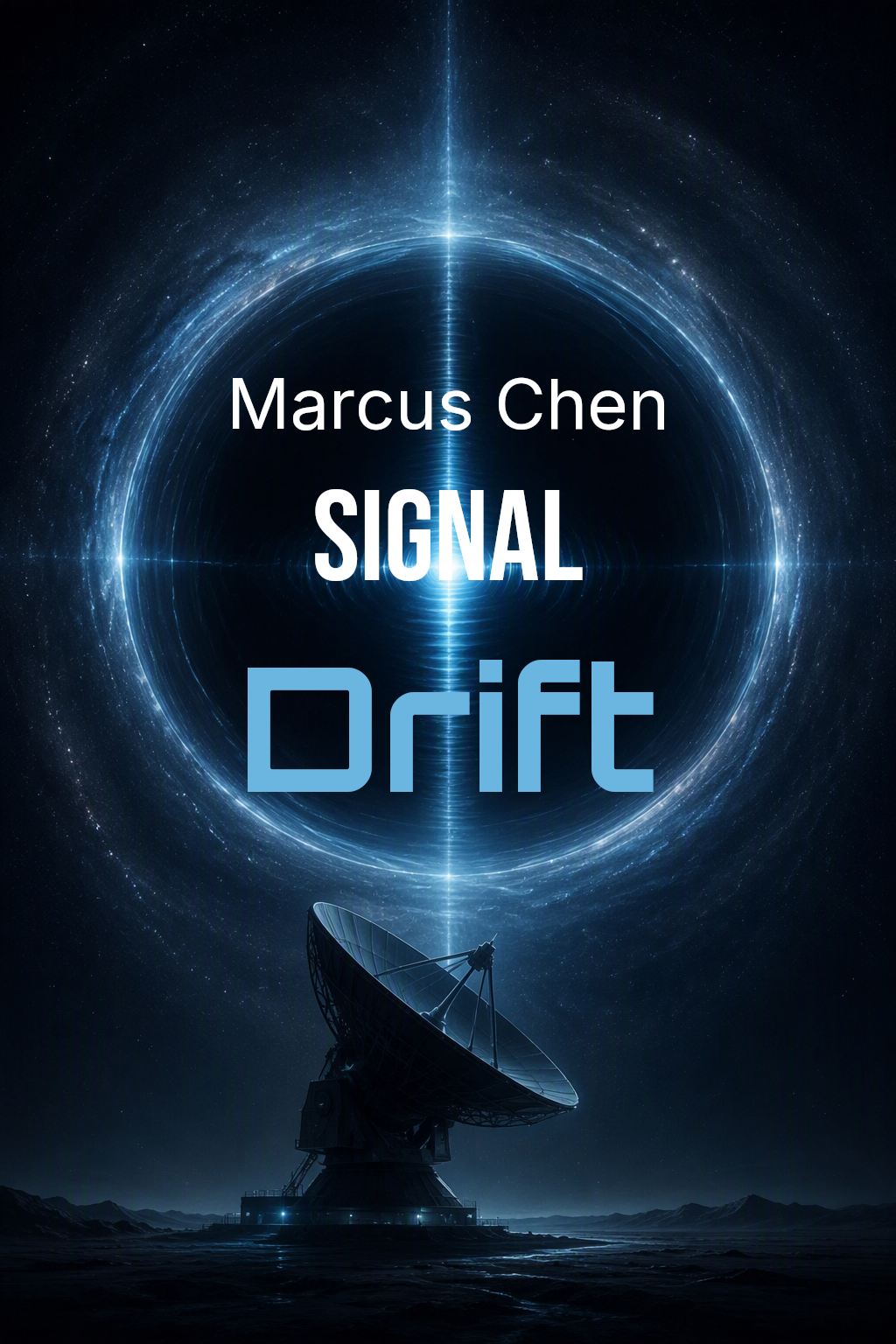
A deep-space communications relay begins receiving transmissions from a star system that does not exist. Radio astronomer Kit Vasquez traces the signal to its source and finds a message that was sent before the universe had stars to send it from.
The Impossible Frequency
The signal arrived on a frequency that should not have existed. Kit Vasquez noticed it at 02:14 local time, during the dead hours of a night shift at the Atacama Deep Space Array, when the only sounds were the cooling fans of the processing racks and the occasional distant bark of a fox in the desert outside. The array's forty-seven dishes were pointed at a patch of sky in Cassiopeia that contained nothing of particular interest — a routine survey sector, empty of known sources, selected by algorithm and monitored by software that flagged anomalies for human review. The anomaly flag that appeared on Kit's screen was tagged low-priority, which meant the software had identified something unusual but not urgent. Kit pulled up the data out of boredom and sat up very straight.
The frequency was 1.42 gigahertz, which was the hydrogen line — the frequency emitted by neutral hydrogen atoms and the single most listened-to frequency in radio astronomy, the one that SETI programs had monitored for decades on the theory that any civilization trying to communicate would choose the universe's most obvious channel. But this signal was not on the hydrogen line. It was beside it, occupying a frequency band so close to 1.42 GHz that it would have been invisible to any instrument less sensitive than the Atacama array, hiding in the shadow of hydrogen's natural emission like a whisper concealedbeneath a shout. It was narrow-band. It was modulated. And it was coming from coordinates that, when Kit checked the star catalogue, corresponded to absolutely nothing.
She ran the coordinates three times. She cross-referenced with every available survey — optical, infrared, X-ray, gravitational wave. The location was empty. Not just devoid of stars, but devoid of anything: no gas clouds, no dust, no dark matter concentrations, no gravitational anomalies. The signal was coming from a point in space that, by every measurement available to twenty-second-century astronomy, did not contain a source capable of producing it. And yet the signal was there, steady and clear and patient, repeating a pattern that Kit, as she watched it cycle, began to suspect was not random.
Melde dich an, um mitzudiskutieren.
Sei der Erste, der einen Kommentar hinterlässt.