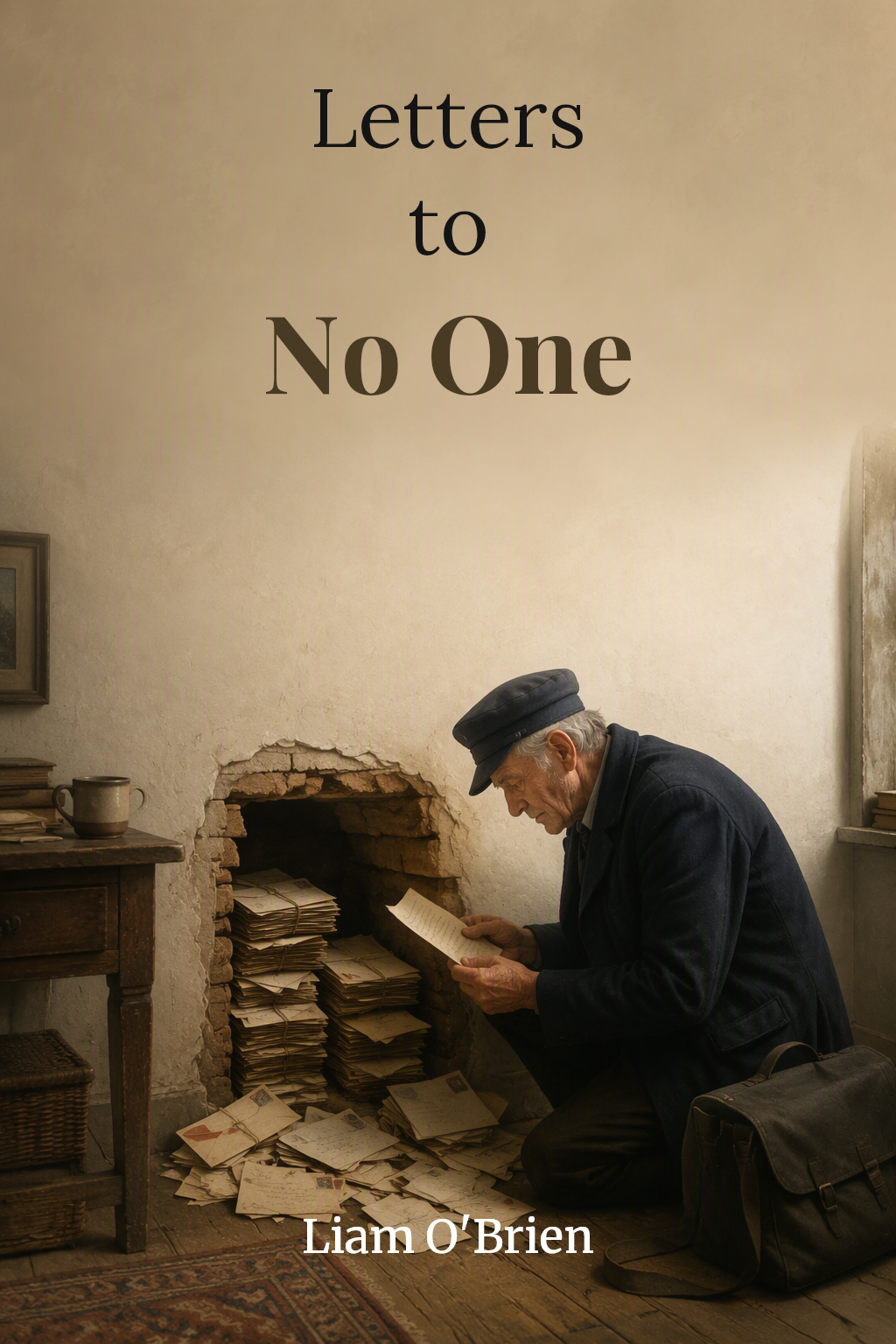

About this Story
A retired postman discovers a cache of undelivered letters in the walls of his cottage — decades of correspondence between strangers, lovers, and enemies, none of which ever reached its destination. As he reads them, he begins to understand that the letters were hidden deliberately, and that the person who hid them had reasons he is only now equipped to understand.
The Wall Speaks
The letters fell out of the wall on a Tuesday in February, when Padraig Dunne was replacing a section of damp plaster in the cottage's back bedroom. He had lived in the cottage for forty-one years, since he took over the postal route for the townland of Cloonagh and was given the tied cottage that came with it, and in all that time, the back bedroom had been a room he used for storage and did not think about. The plaster had been soft for years, yielding slightly when pressed, and he had put off the repair with the comfortable procrastination of a man who lived alone and had no one to answer to about the state of his walls. When he finally took a chisel to it, the plaster came away in sheets, and behind it, in the cavity between the inner and outer walls, was a space that should have contained nothing but stone and mortar and perhaps the skeleton of a mouse.
Instead, it contained letters. Hundreds of them. They were stuffed into the cavity in bundles, tied with string, arranged with a care that suggested not carelessness but intention — someone had put them here deliberately, methodically, over what appeared to be a period of decades. The envelopes were yellowed, the stamps faded, and the postmarks — Padraig turned them over with the automatic eye of a man who had sorted mail for thirty-eight years — spanned from the early 1950s to the late 1980s. They were addressed to peoplein Cloonagh and the surrounding townlands, names Padraig recognized: Brennan, O'Sullivan, Keane, Daly. They were stamped, sealed, and had never been delivered.
Padraig sat on the floor of the back bedroom, surrounded by correspondence that had spent decades sealed in darkness, and felt a sensation he could not immediately name. It was not shock, exactly. It was recognition — the specific, uncomfortable recognition of a man who has spent his professional life ensuring that letters reach their destinations, confronted with evidence that someone in this cottage, before him, had done the opposite. The tied cottage had housed the Cloonagh postman since the route was established. His predecessor, a man named Seamus Forde, had held the route for thirty-five years before retiring in 1984. Seamus had been a quiet, methodical man, respected in the community, known for his reliability. And Seamus, it now appeared, had been stealing the mail.
Sign in to join the conversation.
Be the first to leave a comment.