
About this Story
A Victorian lamplighter discovers one street where the gas flames murmur the names of those who will die before dawn — and tonight a flame speaks his daughter's name.
The-Lamps-Of-Marrow-Lane
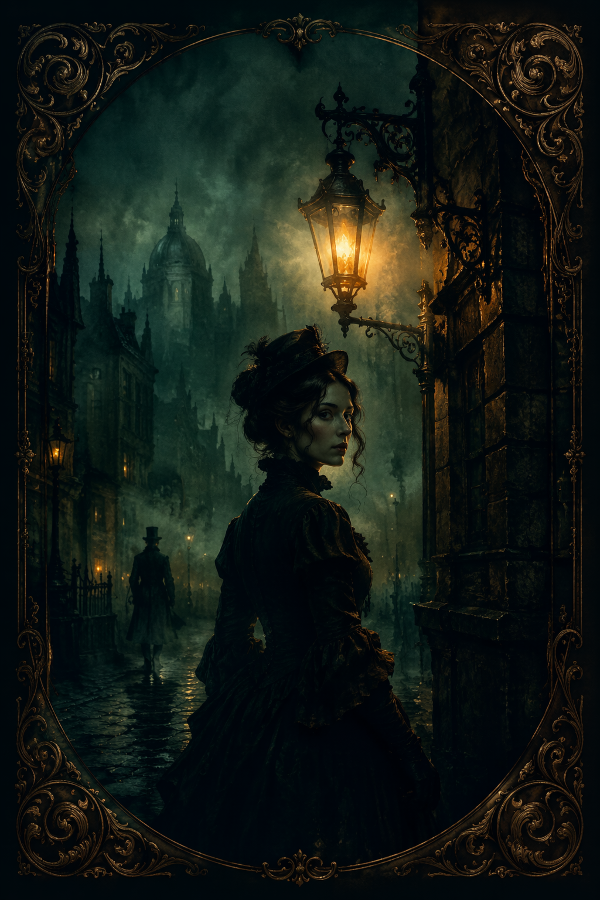
Eliab Quill had lit the lamps of the parish for twenty-six years, and he carried his trade the way other men carried their faith: quietly, in all weathers, and without expecting thanks. Each evening at the failing of the light he shouldered his ladder and his little brass igniter, and walked his round, and one by one the gas-mantles bloomed under his hand — a soft yellow exhalation, a held breath of warmth against the coming dark. The fog rolled in off the river thick as wool. The cobbles shone. He tipped his hat to the cab-men and the constables and the late servants hurrying home, and they tipped theirs to him, for a lamplighter is a respectable sort, a bringer of small mercies, and Mr. Quill was the most respectable of the lot.
He kept his manners polished because they were nearly all he had. His wife had died of the fever three winters past, and he and his daughter Sera lived narrow but clean in two rooms above the chandler's, where she did fine needlework by his lamp-glow and called him Papa in a voice so like her mother's that some nights he had to step out onto the landing to compose himself.
It was on Marrow Lane that he first heard it.
The lane was the oldest in the parish, crooked as a question, its lamps the original cast-iron columns from his grandfather's day. He had lit them ten thousand times. But on a raw November night, with the fog pressing close and theworld gone soft and soundless, he set his flame to the third lamp from the corner, and the mantle caught — and murmured.
He froze on his ladder. He thought it the gas hissing in a faulty fitting. But the sound shaped itself, patient and low, into syllables, into a name: Tobias Frewin. Spoken once, in a whisper like a draught under a door, and then gone, leaving only the ordinary fizz of the flame.
Eliab climbed down with his heart unquiet. Tobias Frewin he knew — a hale old cooper from the bottom of the lane, last seen that very afternoon rolling a barrel and grumbling about his knees. A man with years left in him, surely.
The cooper was found dead in his bed the next morning, gone peaceful in the night, his pipe still warm on the sill.
Eliab told no one. What was there to tell? A grieving widower fancies he hears voices in the gas — they would have him in the asylum by candlemas. So he held his tongue, and he watched, and over the slow weeks of that hard winter he learned the terrible grammar of Marrow Lane. The flames spoke only there, only on certain nights, and only ever one name — and by the next dusk, without fail, the bearer of that name had passed from the world. Old Mrs. Penhallow. The drunkard from the Three Tuns. A child of the washerwoman's, which had near broken him to hear.
He learned to light Marrow Lane with his collar up and his eyes down, and to walk fast, and not to listen. A man can train himself to nearly anything.
But on the night the fog came down like the lid of a box, and he set his igniter to the third lamp from the corner, the flame caught and turned its small blue heart toward him, and breathed a name he knew better than his own.
Sera Quill.
The igniter dropped from his hand and rang against the cobbles. Above the rooftops, very far
Sign in to join the conversation.
Be the first to leave a comment.