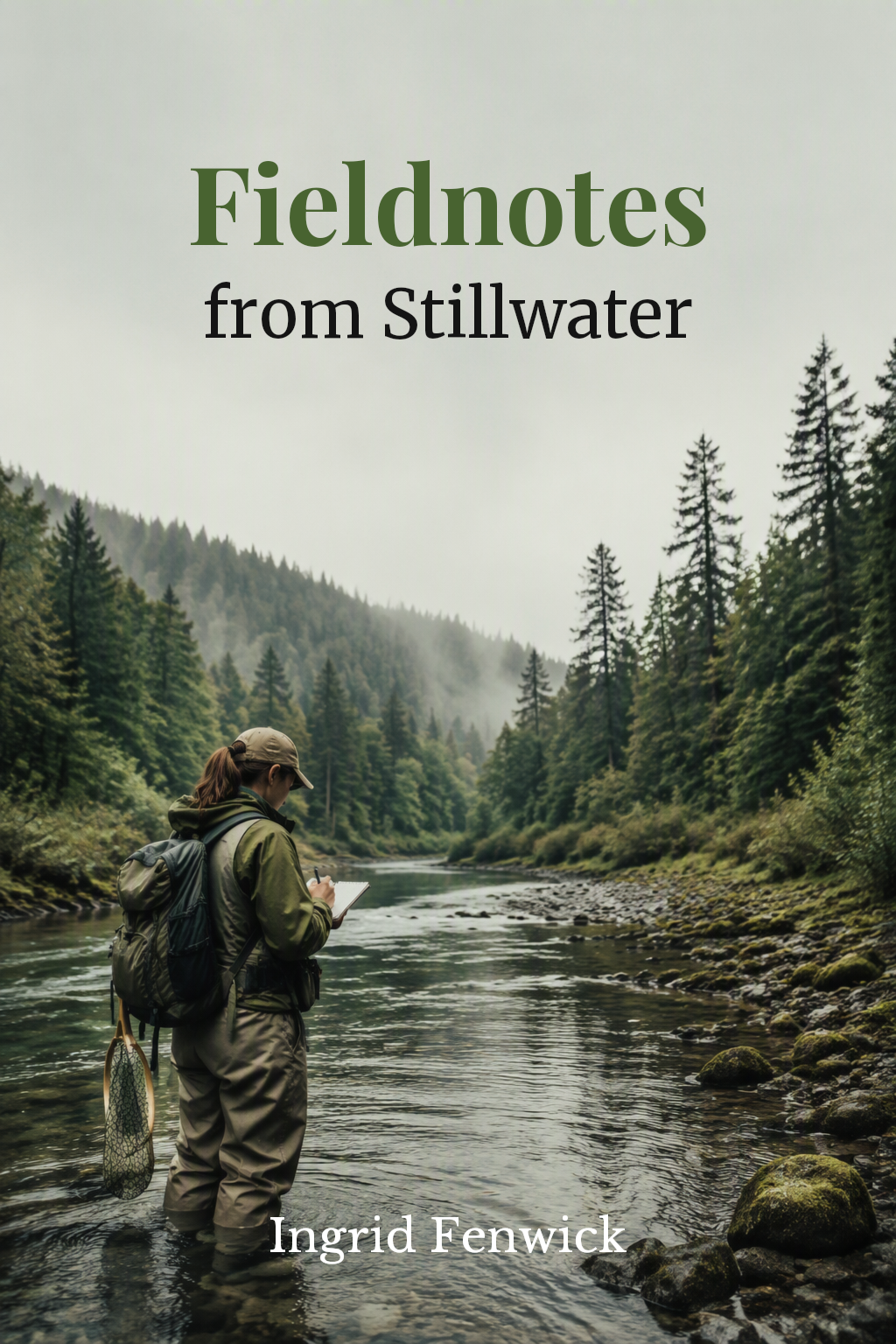

About this Story
For eight years, wildlife biologist Dr. Ingrid Fenwick has walked the same small river in western Washington, counting coho salmon in the rain. Fieldnotes from Stillwater is the record of one working season on a tributary of the Snoqualmie — a watershed threaded through with hatcheries and hobby farms, tribal co-managers and county engineers, an old culvert that stops fish at mile seven, and a family that has said no to her for four years running. Written in the tradition of Annie Dillard and Barry Lopez, these eleven linked essays move from March snowmelt to the first spring after a dam comes down on a neighbouring creek. Part natural history, part political geography, part meditation on what it means to keep count in a depleted world, this is a book about paying very close attention to one small place for a very long time — and about the stubborn, unsentimental hope that grows out of the counting.
The First Count
The first count of the season is always in the rain. This is not a rule written anywhere, only a pattern I have noticed over eight years of walking the same gravel reach of the Stillwater in the last week of March, and it has the force of rule regardless. The sky presses low against the alders. The river runs green-grey with snowmelt from the Cascade foothills forty miles east, a colour that does not occur in the river at any other time of year and that belongs, to my eye, to late winter and to late winter only.
Len arrives at the pull-out at five past seven, which is his usual variant on being on time. He has the waders over one shoulder and the clipboard under his arm and he is already drinking coffee from the dented thermos he has carried since, he says, his first season with the state. He does not say which state, or which season, and I have learned not to ask. Len is sixty-one, a former smokejumper, a man whose right knee is a forecast instrument more reliable than the NOAA model. He was my technician before I was anyone's principal investigator, and the arrangement has survived promotions, a change of funding agency, and one grant cycle so hostile that I briefly considered selling the truck.
Water temp 6.1 C. Air 4 C, light rain, wind SW under 5 kt. Flow estimated 220 cfs from the gauge at Cherry Valley. I write this down standing on the bank, the notebook alreadypearling with droplets across the Rite in the Rain paper, the pencil making its careful grey tracks. Writing is the first act of every field day. Before we walk, before we count, before we speak much to each other, we write down what the morning is.
The reach we index here is only four hundred and eighty metres long. It runs from a cottonwood stump with a painted red dot at its base — a dot I repaint every other year in marine enamel, against the weather — to a culvert under a private driveway where the river briefly ducks underground and comes up changed. Between those two points the Stillwater does nothing dramatic. It riffles. It pools. It riffles again. A side channel opens in high water and closes by August. There is a log jam that shifts downstream about half a metre each winter and will, eventually, take out the footbridge at Edwards' place, though not this year and probably not next. This is the index reach. We have walked it in April and again in October every year since 2018, recording every live adult coho, every redd, every carcass we can identify to sex, every passage obstacle we have not already counted. The purpose is not discovery. The purpose is continuity. Continuity is how a watershed tells you what it is doing, if you are prepared to listen for twenty years.
Coho in late March are juveniles, mostly — yearling smolts on their way downstream to the estuary, some still silvering out from the parr marks of their first year. We are not here to count them as much as to catalogue the water they leave behind: the gravels they have overwintered in, the undercuts they have used as cover, the algal mats that tell me what the winter chemistry was doing when I was not looking. We pull out a surber sampler at station three and take the benthic count. Stoneflies,
Sign in to join the conversation.
Be the first to leave a comment.