
About this Story
The last dragon hoards not gold but the final words of everyone who died alone — and a scribe whose voice is failing climbs the mountain to give it hers before she can no longer speak.
The-Climb
The mountain was called Sorrowmount, but only by people who had never climbed it. The ones who came back called it nothing at all, because by then they had heard what lived at the top, and some things you do not give a name to in case the name comes when you call.
Eli climbed slowly, which was the only way her body let her climb now. The cough had started in the spring as a tickle and had become, by autumn, a thief. It took her breath first, then her words, a few at a time, so that some mornings she woke and could not find the name of the bird outside her window, though she had known it all her life. The physicians in the lowland town had been kind and useless. Save your voice, they told her, as if a voice were a coin you could put away in a drawer. They did not understand that for a scribe, the voice was not the coin. It was the well the coin was drawn from.
She had spent thirty years writing down what other people said. Wedding vows, deathbed confessions, the last instructions of farmers to their sons. She had a good ear and a steady hand and she had never once, in all those years, written down a word of her own. There had never seemed time. There had always been someone else with something to say and only so long left to say it.
Now the someone with little time left was her.
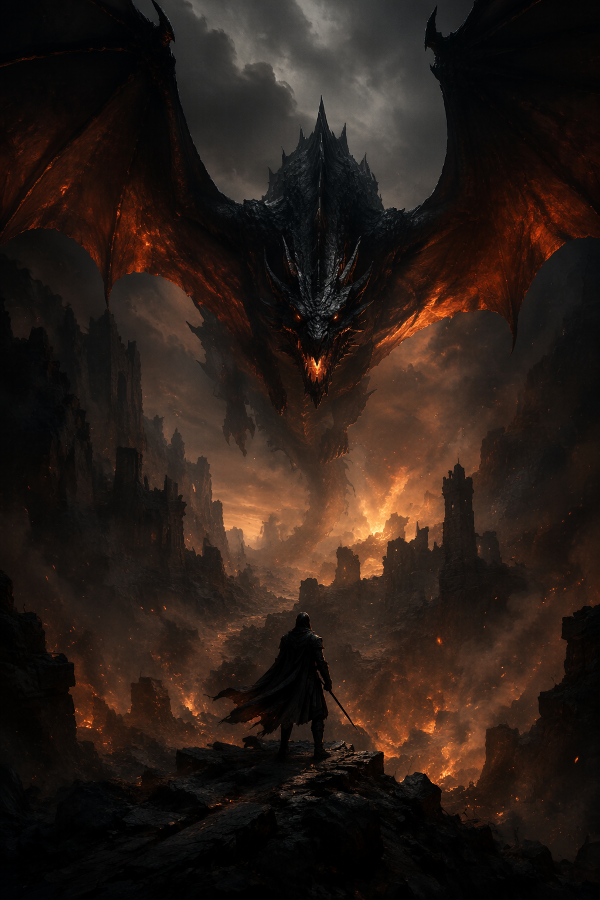
She rested where the path bent against a shelf of black stone, and she heard, far above, a soundlike a great slow bellows — the breathing of something enormous and patient. The villagers had a story about it. They said that in the old days, when dragons still claimed the high places, they had hoarded gold the way rivers hoard stones, without meaning to, simply by being where things gathered. But the gold was long gone, melted into the coin of fallen kingdoms, and only one dragon remained, and it hoarded something stranger now.
It hoarded last words.
Not the grand ones. Not the words said in warm beds with children gathered round, the words that got remembered and carved and repeated until they wore smooth. The dragon, the story said, took only the words of those who died alone — in ditches, in locked rooms, in the wide indifferent dark where no scribe sat with a steady hand to catch them. Words that would otherwise have fallen into the ground unheard. The dragon caught them as they fell. It kept them the way another creature might keep warmth.
Eli had not believed the story. She had written down a hundred stories like it and believed none of them. But she believed in her own failing throat, and in the arithmetic of it: that very soon she would have a last word of her own, and that when she did, there might be no one in the room.
She had spent her whole life making sure other people's final sentences were heard.
She did not intend to let hers go unkept.
So she climbed, with a flask of cold tea and a wax tablet she could no longer be sure she'd have the breath to use, toward the slow breathing at the top of the mountain that had no name — to give the last dragon, while she still had the words to give, the thing she had spent a lifetime collecting for everyone but herself.
Sign in to join the conversation.
Be the first to leave a comment.