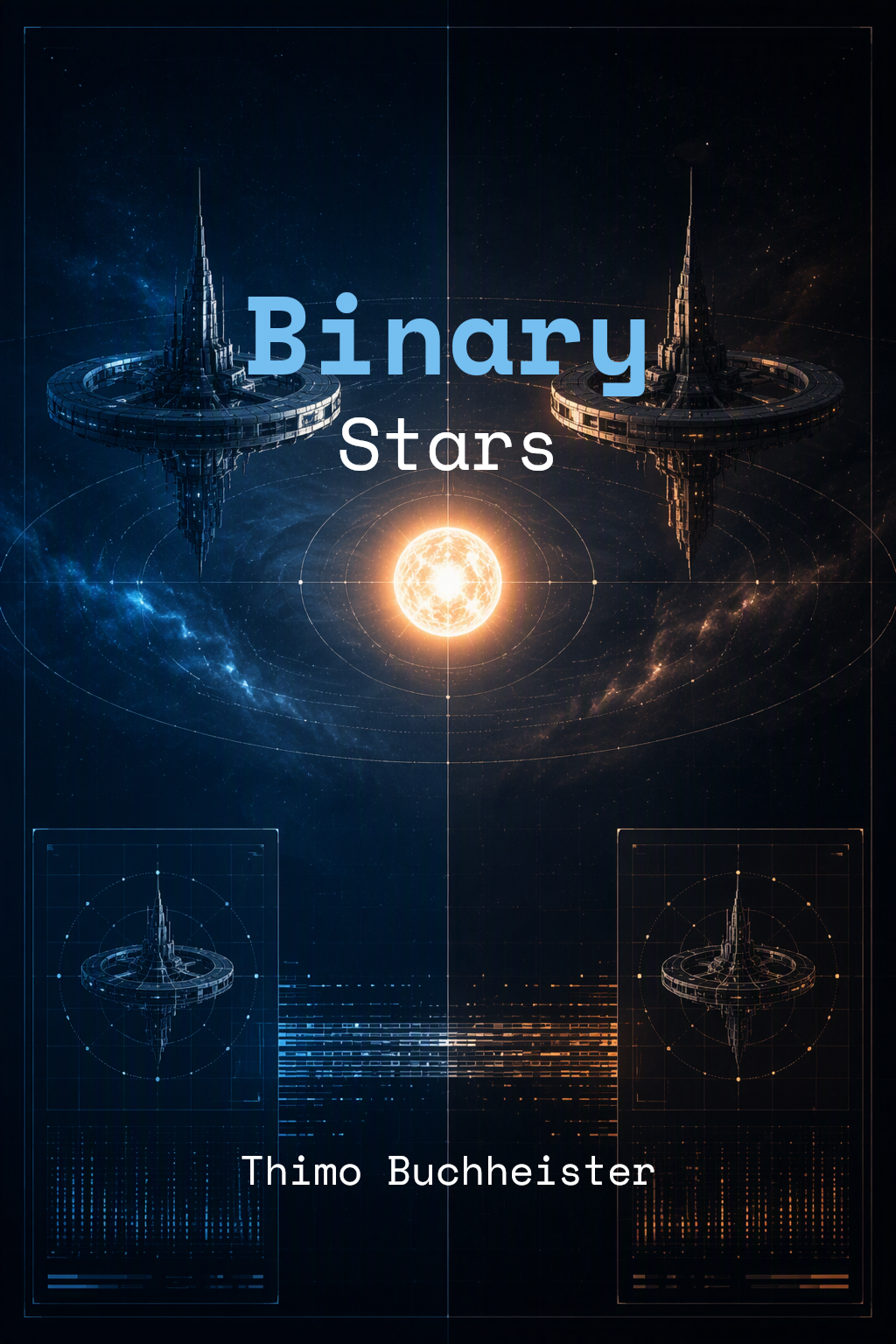

About this Story
Two space stations orbit the same dying sun, each unaware the other exists. When a data leak bridges the gap, both crews must decide what it means to discover you are not alone — and never were.
The Signal
Commander Yael Ortiz had spent eleven years watching the sun die. From the observation deck of Station Halcyon, the star designated KOI-7842 filled the viewport like a vast amber eye, its surface mottled with the dark granulations that marked the final stage of hydrogen depletion. The station's mission was to document the death — to record every fluctuation, every coronal ejection, every shift in the spectral signature — so that the data could be transmitted back to the colonial fleet and used to predict the lifespan of the six hundred other stars humanity now orbited. It was important work. It was also, Yael had come to understand, profoundly lonely work.
The anomaly appeared in the background radiation data at 03:47 station time, buried in the noise floor of the heliospheric sensors. Yael's analyst, Dr. Fenn, flagged it during the morning review — a repeating pattern in the microwave band that did not correspond to any known stellar phenomenon. It was too regular to be natural. Too complex to be an echo. When Fenn ran it through the signal-processing suite, the pattern resolved into something that made both of them sit in silence for a long time: a data packet. Compressed. Encrypted. Using a protocol that Yael recognized, because it was the same protocol Station Halcyon used for its internal communications.
Someone was broadcasting on their frequency. Someone close. Someoneusing their own technology. And the signal was coming from the other side of the sun.
Sign in to join the conversation.
Be the first to leave a comment.