
Science-Fiction Subgenres: Definitions, Examples, Characteristics
Science fiction is narrative literature whose core is a scientific or technological innovation, a so-called novum, that distinguishes the depicted world from our own. The most important subgenres are Hard-SF, Soft-SF, Cyberpunk, Space-Opera, Dystopia and Post-Apocalypse, Time Travel, Alternate History, Steampunk, Biopunk, Cli-Fi, Solarpunk, Military-SF and Science-Fantasy. Three signals quickly reveal where a work belongs: Is technology or society at the center? Does the action take place in space, on the near Earth or in a distant future? And is the tone sober-analytical or rather epic-adventurous?
This overview provides for each of the mentioned subgenres a compact definition, typical narrative patterns and a concrete example, so that you can classify a book or a film at first glance.
Key insights
Science fiction can be reliably assigned to one of the established subgenres based on novum, setting and narrative focus, even though many works deliberately mix several of them.
| Thema | Details |
|---|---|
| Kernkriterium für SF | A scientifically or technologically justified novum distinguishes SF from fantasy. |
| Hard-SF vs. Soft-SF | Hard-SF emphasizes technical accuracy; Soft-SF foregrounds society and psychology. |
| Hybride richtig lesen | Science-Fantasy works when magic has its own rules and limits like a technology. |
| Schneller Zuordnungstest | Focus, setting, narrative scale and style answer almost every genre question in four questions. |
| Subgenres praktisch testen | Short stories and audio samples reveal the tone and tropes of a subgenre faster than a whole novel. |
Table of contents
- What distinguishes science fiction from fantasy?
- The most important subgenres of science fiction at a glance
- How do hybrid genres like science-fantasy arise?
- How do you quickly recognize the appropriate subgenre?
- How do you find your next sci‑fi subgenre to try out?
- Sources
- FAQ
What distinguishes science fiction from fantasy?
Science fiction grounds its novum scientifically or technologically, even if the explanation remains speculative. Fantasy, by contrast, works with magic or supernatural principles that do not require a scientific justification. The German Wikipedia entry on science fiction describes this dividing line using the concept of the novum and distinguishes Soft-SF, which deals with social and philosophical questions, from Hard-SF, which emphasizes scientific accuracy.
Three example pairs make the boundary clear. Isaac Asimov's robot stories explain artificial intelligence through rules of logic, not magic. Herbert Franke writes about the consequences of technology with similar sobriety. Star Wars, by contrast, uses the Force as a principle that is more spiritual than physical, which is why many critics classify the series as science-fantasy.
Arthur C. Clarke formulated the principle that any sufficiently advanced technology is indistinguishable from magic. That very thought instrument is used by a German-language guide to genre boundaries to classify borderline cases: If an ability is treated as an explicable system, the work tends toward SF. If it remains mysterious and unexplained, it is fantasy.
The most important subgenres of science fiction at a glance
An detailed genre guide and the English-language Outline of Science Fiction list dozens of subcategories, but the following subgenres form the core of any reading list.
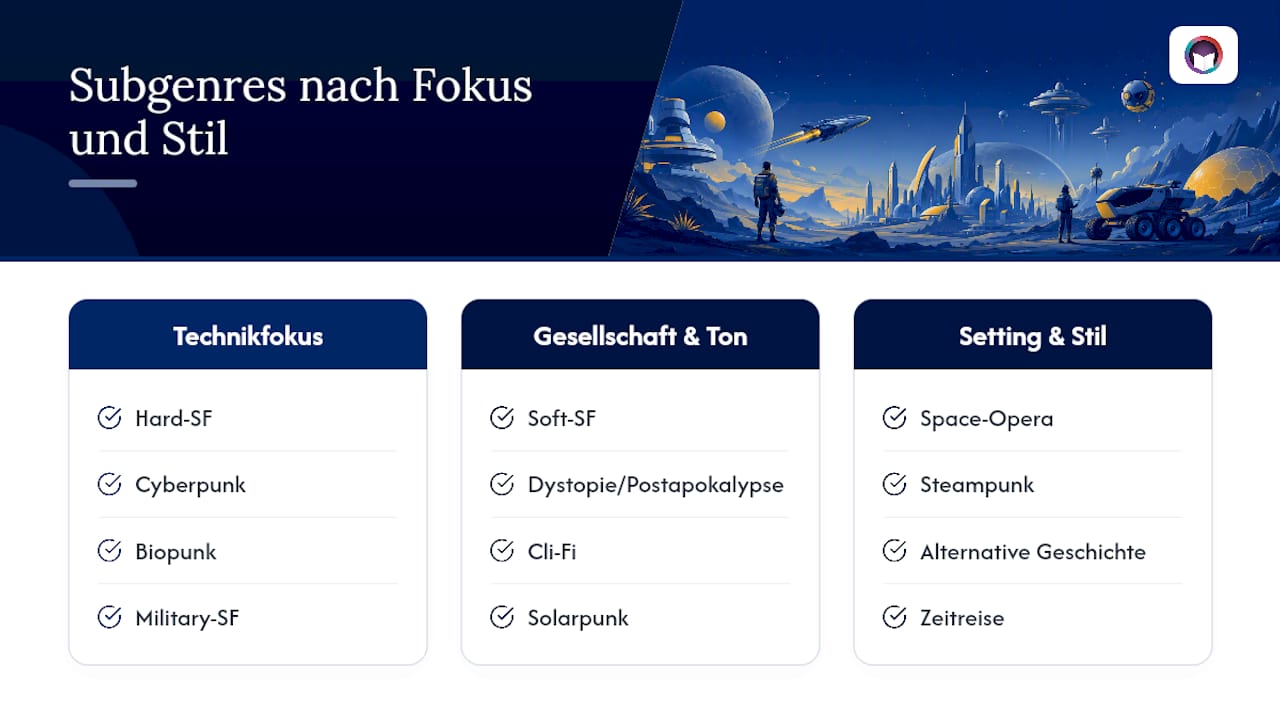
Hard-SF prioritizes scientific accuracy above all. Physics, biology, and technology operate according to comprehensible rules, often worked out in detail. Isaac Asimov, with his laws of robotics and the Foundation series, is regarded as the most formative representative of this strand, because he treats technology not as a trick but as a system.
Soft-SF foregrounds society, psychology, or politics, while technology remains more of a backdrop. Ursula K. Le Guin's works on gender and governance are the classic example of how little engineering details need to matter.
Cyberpunk depicts megacorporations, hackers, and digital realities in a rundown future. William Gibson's Neuromancer practically founded the subgenre and still provides the blueprint today: street slang meets corporate power, body meets network.
Space-Opera tells epic tales about galaxies, empires, and space battles. Frank Herbert's Dune shows how close Space Opera can come to science-fantasy, because alongside interstellar politics, mystical abilities such as the Fremen's prescience are at the center of the plot.
Dystopie und Postapokalypse deal with collapsing or totalitarian societies. The Road by Cormac McCarthy depicts survival after a nameless catastrophe in radical reduction, while Station Eleven by Emily St. John Mandel shows a pandemic future in which art and memory stand against decay.
Time travel revolves around paradoxes, alternate timelines and the question of whether history can be changed. Typical tropes include the grandfather paradox and time loops.
Alternate history poses the question: What if a historical event had gone differently? It often deals with changed war outcomes or shifted technological developments.
Steampunk relocates futuristic technology to the Victorian era, powered by steam engines instead of electronics. Gears, airships and corset aesthetics shape the visual style.
Biopunk treats genetic engineering, biohacking and control over the body as central conflicts, often with corporations as antagonists.
Cli-Fi, short for climate fiction, tells stories about climate change and ecological collapse. A book blog with short dystopian novels offers a compact reading list for anyone who likes to dive into dystopian scenarios.
Solarpunk turns the climate crisis into a positive and designs sustainable, often solar-powered future societies as an antithesis to dystopia.
Military-SF focuses on war, military hierarchies and weapon technology in space or on alien planets, often from the perspective of ordinary soldiers.
Science-Fantasy blends technology with magic or myth. Dune with its supernatural abilities and Star Wars with the Force show how fluid this transition can be.
When browsing a bookstore or streaming catalog, a simple look helps: If the tone appears sober and explanatory, the work tends toward Hard-SF or Cyberpunk. If it feels epic and mythically charged, you have probably landed in Space-Opera or Science-Fantasy.
How do hybrid genres like science-fantasy arise?
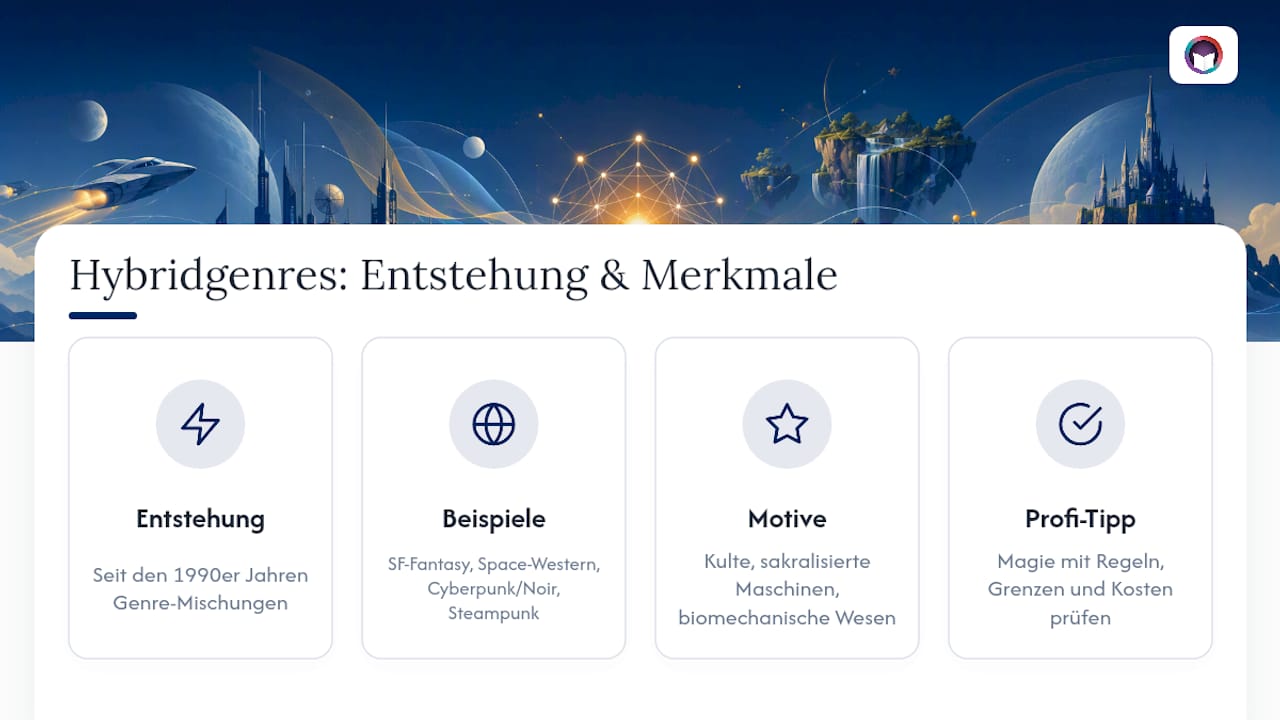
Since the 1990s, science fiction has increasingly mixed with other genres instead of remaining in pure form. Common hybrids include science-fantasy, space westerns, the combination of cyberpunk and film-noir as well as steampunk with woven-in fantasy elements like fairies or spells alongside steam technology.
A hybrid works as long as magic and technology interlock logically in the worldbuilding, instead of standing arbitrarily side by side. Analyses of science-fantasy name typical motifs for this: techno-religious cults, sacralized machines or biomechanical beings in which myth and apparatus form a unity.
Pro tip: Check whether a magical power in the text has its own rules, limits and costs. If it does, it reads almost like technology and the hybrid sustains itself.
How do you quickly recognize the appropriate subgenre?
Four questions are usually enough to classify a work cleanly:
- Is the focus on technology and its consequences or on societal and interpersonal questions?
- Where does the action take place: on the near Earth, in the solar system or spread across whole galaxies?
- Is the narrative scale intimate (a family, a city) or epic (empires, wars)?
- Which style dominates: sober-analytical, noir-dark, adventurous or military?
Certain tropes reveal the subgenre almost on their own. Megacorporations and hacked implants point to Cyberpunk. A climate catastrophe as the plot driver indicates Cli‑Fi. Gears and airships signal Steampunk.
Pro tip: If you're unsure, look at the story's first threat. If it's technical in nature, it's usually SF. If it's supernatural and unexplained, it's usually fantasy.
How do you find your next sci‑fi subgenre to try out?
Short stories are the quickest way to really get to know a subgenre, because you experience tone, tropes and narrative perspective in a few minutes instead of over an entire novel. Outastory is perfect for exactly that: you read or listen to short stories from science fiction and adjacent genres for free, with professionally produced voices or the author's own voice.
A few practical approaches for getting started:
- Search specifically for keywords like Cyberpunk, Dystopia or Time Travel to listen through content within a subgenre.
- Use audio samples to distinguish noir-heavy narrative perspectives from epic-adventurous ones.
- Jump between serial stories that appear chapter by chapter to test whether a slow build-up of suspense suits your subgenre taste.
The platform is available in German and English; authors publish their texts in a few minutes and participate in the revenues from their stories. If you write science-fantasy or cli‑fi yourself, you can find the direct entry to publishing on the Outastory homepage.
Sources
- Science‑Fiction — Wikipedia
- Visual and Literary Description of Sci‑Fi Subgenres
- Outline of Science Fiction — Wikipedia
- Where Science Fiction Ends and Fantasy Begins — Literaturtipps
FAQ
How many subgenres of science fiction are there?
There is no fixed number, since subgenres are constantly recombining. Several dozen are considered established, including Hard-SF, Cyberpunk, Space-Opera, Dystopia and Cli‑Fi.
Who are the "big three" of science fiction?
This usually refers to Isaac Asimov, Arthur C. Clarke and Robert A. Heinlein, who shaped the golden age of Hard-SF and Space-Opera.
Name five examples of science fiction works
Neuromancer by William Gibson, Dune by Frank Herbert, Station Eleven by Emily St. John Mandel, The Road by Cormac McCarthy and the Foundation series by Isaac Asimov together cover five different subgenres.
What are the eight main genres of fictional literature?
The classic main genres usually include Fantasy, Science-Fiction, Crime, Thriller, Horror, Romance, Historical Novel and Literary Fiction, with Science-Fiction further dividing into the subgenres described here.
What distinguishes Cyberpunk from Space-Opera?
Cyberpunk typically takes place in a rundown near-future on Earth and revolves around corporations and networks, while Space-Opera tells epic stories across galaxies and empires.
Recommendation
Read and write on OutaStory
Thousands of short stories to read for free — or publish your own and find an audience.